

Recently Rod Dreher included in his daily newsletter a picture (which we’ll get to) under the heading:
“We Murder to Dissect”
—Wordsworth
I looked it up and the phrase is from William Wordsworth’s poem The Tables Turned written in around 1798, so pretty much at the height of the Enlightenment (hence the impulse to dissect) but also early Romanticism following upon Rousseau, who said we’re all wonderful except as society corrupts us (hence the self-flagellation). The last two verses are:
Sweet is the lore which Nature brings;
Our meddling intellect
Mis-shapes the beauteous forms of things:—
We murder to dissect.
Enough of Science and of Art;
Close up those barren leaves;
Come forth, and bring with you a heart
That watches and receives.
So in the picture you see leaves of some sort of fir, maybe a balsam fir, on a cut-off stem with four further sub-stems. (Even removal from the tree is a bit of “dissection,” really, but that’s not the point here). In the next picture is a true dissection, the leaves having been removed from the stems and arranged in stacks corresponding to the stems from which they’re removed. The arrangement of leaves and stems constitutes a sort of analysis. You can count to determine the typical number of leaves by length of stem, for example.
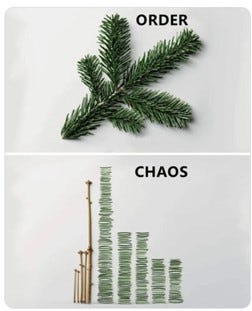
Order and Chaos
What so interests me about the picture is inclusion of the words “order” and “chaos.” The top picture is marked “orderly” and that’s correct, because the natural formation of a fir tree would include growth of sub-stems on a main stem and leaves on both in position to maximize benefits of light and air and water. This creates a readily-recognizable form for the fir tree. The leaves are symmetric around the stem and similarly shaped. It is pleasing to look at precisely because it is orderly.
But then the second part of the picture is marked “chaos.” Does it really show something chaotic? The parts of the stem are further broken out into sub-stems with leaves removed, but it’s arranged quite orderly. You might say the first picture is God’s order, and the second mankind’s misguided technocratic “order.” The second picture is not beautiful because it’s not natural, but we may take it for our scientific purposes to be more usefully informative. So there’s the worst instincts of mankind’s “order,” and there’s “natural order,” and these can be two different things.
One reason this fascinates me is because we can readily see that the designation “chaos” is nonetheless correct. Our “dissection” of nature is precisely the thing that reduces order to chaos. I don’t mean we should have nothing to do with nature so as to leave it entirely undisturbed. We impact our environment, sometimes abusively, but impact per se is not a bad thing. We were tossed out of the garden to make it in a world of thorns, but there’s food and shelter here, we just have to work for it. It is for us, but we have to steward it. We experience God through nature, and we experience nature through God.
Nature
I’m referring to “nature,” but I don’t just mean the plants and animals and seas and terrain and atmosphere. I’m referring really to all of material reality. By our senses we can perceive our environment, but more importantly we can perceive the order inherent in it, and in our brains able to register that orderliness and reason from it. The world is orderly and so are our minds. When you’ve read me go on and on about the “natural order” of the universe, this is what I’m talking about.
To destroy or “dissect” or disavow or disapprove of the natural order is to revert in some degree to the primordial chaos from which the natural order is drawn up by the love of God. Wanton destruction is an illustration of the human tendency to interfere; to dethrone God and attempt to take His throne for ourselves. It’s the tower of Babel all over again. It’s the dissection of nature that required the Flood. It is Cain’s building of cities when he was supposed to be wandering the earth. It is the machine- and war-building instincts that the lineage of Cain through Tubal-Cain identifies to us. More prosaically, it is a picture of how we try to impose our own order but in doing so destroy God’s order.
Spirit of Negation
To be clear, I’m not just talking about environmental travesties. I’m talking also about ways of thinking that depart from the natural order. I’ve called it in various essays the “spirit of negation,” and I think that spirit is what follows upon rejection of objective truth/falsity and good/evil and beauty/ugliness in the world. These fundamental elements of our existence are part of the natural order. The spirit of negation follows—and necessarily follows—upon rejection of absolute truth and absolute moral values because truth- and moral-relativism is rejection of the natural order.
I follow my intellectual interests wherever they lead, lucky me, and often they converge serendipitously. And so it is this time: in various essays, some published and some pending, I wrote at length about the spirit of negation and where it comes from, to try to establish that it’s a real thing creeping upon us, rather than just collective pessimism.
The philosopher Eric Voegelin’s work is helpful on this, ascribing the emergence of ideologies to rejection of the natural order. He calls them “Gnostic” because they presuppose esoteric knowledge of “truth” not tied to that order. Likewise Max Sheler (“apostasy”) and Father Seraphim Rose (“nihilism”), and likewise from the other side, postmodern “critique” starting with Marx, Freud, and Nietzsche, but including Marcuse, Dewey, Rorty, Foucault, and the vast majority of humanists in academia since the mid-century War. We’re so submerged in the spirit of negation that we’re in danger of never breaking the surface, in our lifetimes.
Ideology
The spirit of negation inheres in ideology. To be clear, I mean “ideology” pejoratively: self-sustaining systems of thought that first break from ultimate questions of first and last, the origin of the natural order we experience every day. You might say the natural order equates to common sense, and so deviation from it is ideological by definition. Still, how does accepting the natural order keep us from spinning off centrifugally from common sense, causing us to “critique” everything on a presumption of bad faith? I’ve said a hundred times, with Solzhenitsyn, “men have forgotten God, that’s why all this happened.” Not just the gulag, but the ideology that produced it. And not just that particular ideology—Bolshevist communism—but all ideologies, each a sprig of the same poisonous tree, rejection of natural order. I know in my guts the connection is valid.
Stay tuned. In the next part we get a better grasp on what “natural order” means, and what “ideology” means, and how ideologies form upon rejection of natural order.